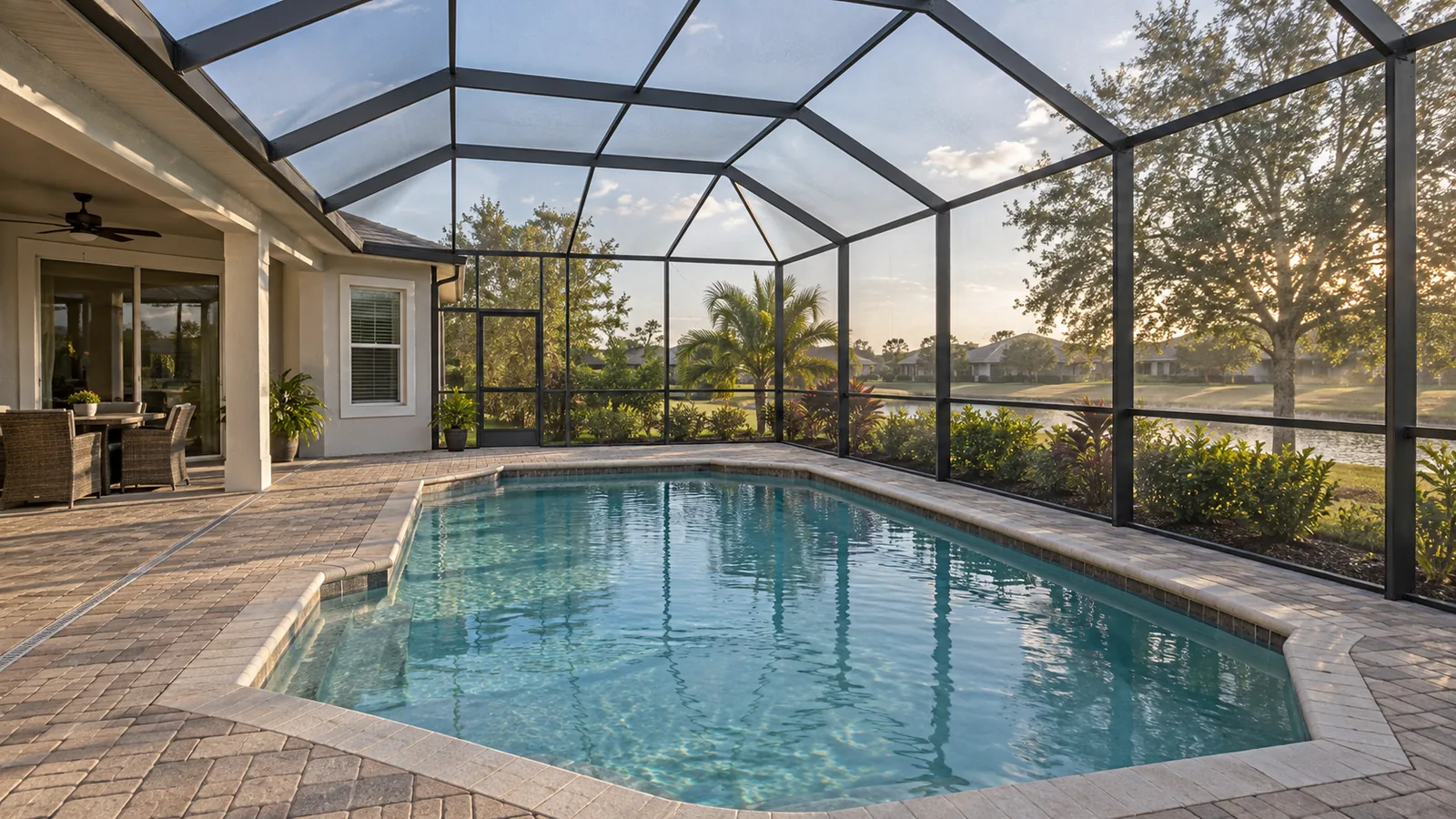
The short answer
Rescreen a pool cage when panels are sagging, torn or brittle, when the spline holding the screen has dried out and is pulling from its channel, or when sun-faded roof panels crumble to the touch. If only a few panels are damaged, replace those; if many are failing from age, a full rescreen is usually better value. HomeGuide's 2026 national figures put panel repairs at about $25 to $65 per panel and a full rescreen at about $1,200 to $3,500.
Choose the mesh by what matters most in each area: standard 18 by 14 mesh for most walls and roofs, a finer no-see-um mesh where tiny biting insects are a problem, pet-resistant screen on lower panels and solar screen where you want shade. Denser, heavier screens catch more wind, so check with the installer before changing the whole cage to them.
Key takeaways
- Roof panels facing the sun fail first. Inspect them every spring, not only the walls you can see.
- Replacing panels one at a time costs more per panel over the years than one full rescreen.
- Refinish the aluminum before rescreening. Paint and new screen should not happen in the reverse order.
- Heavier screens such as solar and pet mesh add wind load. Use them where they are needed, not everywhere by default.
- Storm damage is not automatically covered. Many Florida policies limit or exclude screen enclosures, and deductibles apply.
Signs It Is Time to Rescreen
The frame of a pool cage is built to last for decades. The screen is not. Sooner or later, the mesh stretched across it sags, fades and tears, and the question is whether to patch or replace it.
Look up first. Roof panels take the most sun and the most falling debris, and they are the ones owners notice last. Signs of age are the same everywhere:
- panels sagging or billowing in the wind instead of lying taut;
- mesh that is faded, chalky or brittle, and crumbles when pressed;
- small holes and tears multiplying, especially along the edges;
- spline, the rubber cord that holds the screen in the frame, popping out or cracking;
- more insects and leaves inside the enclosure than there used to be.
A few damaged panels after a storm or a falling branch call for repair. Widespread fading and brittleness mean the screen has reached the end of its life.
How Long Screen Lasts in Florida Sun
There is no fixed number. Screen life depends on the mesh, how much direct sun each panel receives, how often it is hit by branches and debris, pool chemistry in the air and how well the spline holds. The same enclosure can have wall panels in good shape and roof panels on the sunny side that are finished.
Fiberglass mesh degrades as ultraviolet light breaks down its coating and fibers, which is why sun-facing panels age first. Spline dries out and shrinks over time, letting screen loosen even when the mesh itself is intact. Rather than planning around an age, inspect the enclosure every spring and after major storms, and act on what you find.
Mesh Types: Standard, No-See-Um, Pet, Solar
Screen choice is a balance between visibility, airflow, insect protection and toughness. Four families cover most pool cages.
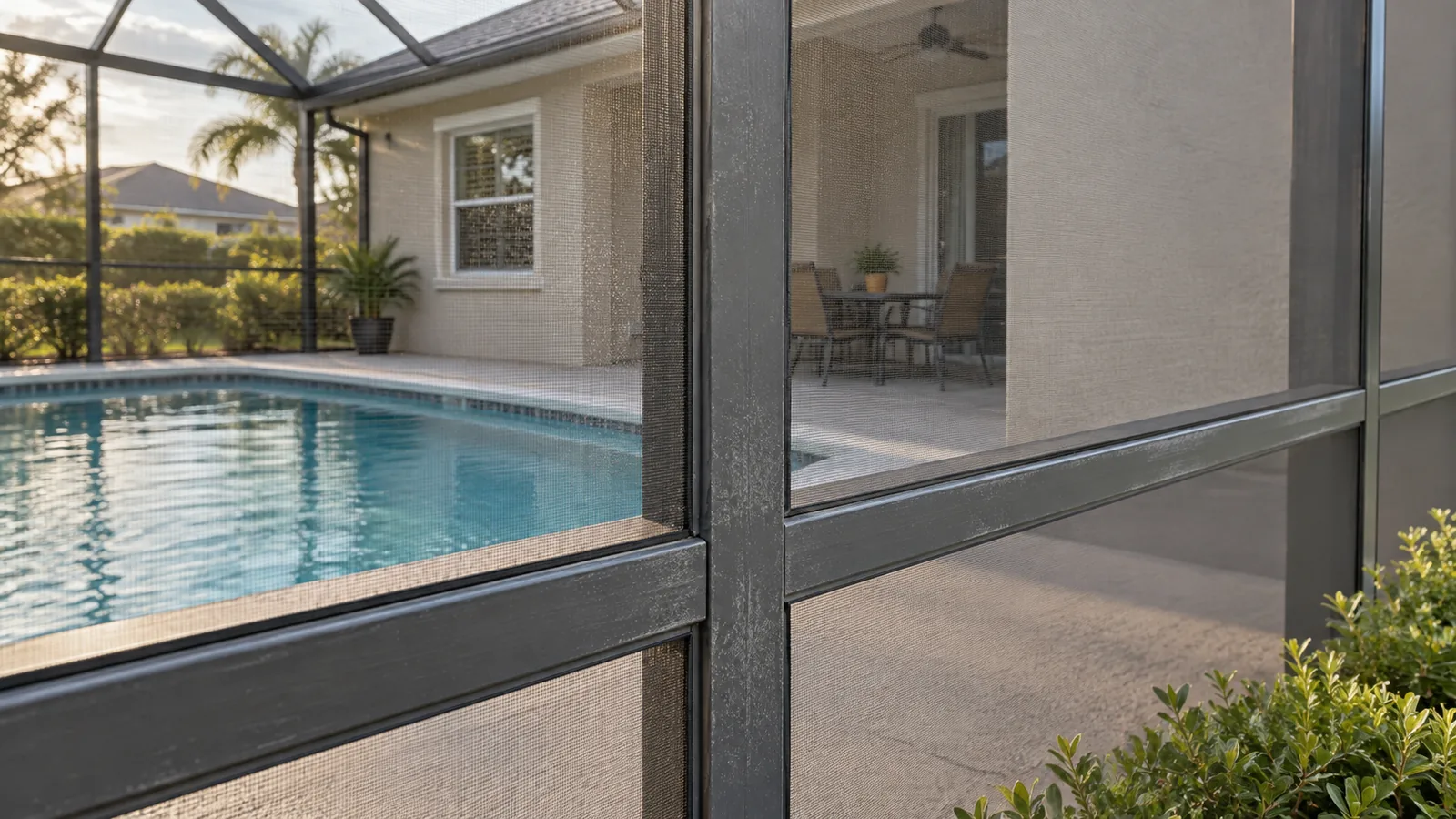
Standard pool and patio mesh is usually an 18 by 14 fiberglass weave, heavier than window screen and designed for the large spans of enclosures. Phifer, one of the main screen manufacturers, describes its 18 by 14 pool and patio screen as the most specified product for pool and patio enclosures. It gives good visibility and ventilation.
No-see-um mesh uses a tighter weave, commonly 20 by 20, to stop the tiny biting insects that pass through standard screen near lakes, ponds and wetlands. The trade-off is slightly less airflow and visibility.
Pet-resistant screen is made from heavier vinyl-coated polyester that resists claws and paws. It is usually installed on the lower panels, where pets and children make contact, rather than across the whole cage.
Solar screens, such as Phifer’s SunTex line, are dense vinyl-coated polyester meshes that the manufacturer rates at roughly 80 or 90 percent shading. They cool shaded seating areas noticeably but reduce the view and airflow, and they are usually used on specific walls rather than everywhere.
Mesh is only one part of a cage. Its frame, roof style and the wind engineering of the enclosure itself are separate decisions that matter mostly when you are building or replacing a cage.
Full Rescreen vs Panel Replacement
Panel replacement makes sense when damage is localized: a branch through two roof panels, a torn door panel, a pet’s work on a lower wall. It is quick and affordable.
A full rescreen makes sense when the screen as a whole is old. Replacing panels one at a time as they fail costs more per panel over the years, leaves the cage looking patchy as new dark panels sit next to faded ones, and means repeated service calls. HomeGuide notes that companies typically price small repairs per panel and full rescreens by the square foot, and that piecemeal replacement is more expensive over time than a single full rescreen.
A practical rule: when you find yourself repairing panels every few months, the rest are close behind.
Spline, Hardware and Frame Inspection
A good rescreening crew inspects the parts it is working on, because rescreening is the only time most of the frame is looked at closely. Expect them to check the spline channels, which can be bent or corroded; the screws and fasteners at the joints; door hinges, closers and latches; and the condition of the aluminum where screen is attached.
Spline is replaced along with the screen. Using the correct diameter for the channel matters, since spline that is too thin lets screen pull out in the wind and spline that is too thick stretches the mesh unevenly.
Super Gutter Leaks
The super gutter along the house carries the roof of the cage and the rain from the house roof. Leaking seams and failed sealant drip onto the deck, stain the fascia and, over time, can damage the wood behind it. Resealing gutter seams is a small repair best done while the crew is already on the roof.
Anchor Corrosion
Where posts meet the deck, look at the brackets and anchors. Irrigation overspray, pool water, salt systems and standing rain all accelerate corrosion at the base. Surface staining is cosmetic; anchors that are loose, rusted through or pulling out of the concrete are structural. At that point the question is no longer rescreening but whether the frame needs repair or replacement, and that call belongs to someone qualified to assess the structure, not to the screen crew.
Kick Plate Replacement
Kick plates, the solid aluminum panels at the bottom of the walls, protect the lowest screen from feet, furniture and mowers. Dented, corroded or loose kick plates can be replaced during a rescreen, and adding them where there were none is a simple way to protect new screen.
Doing It Before or After Painting the Cage
If the aluminum frame is chalky, faded or showing bare spots, refinish it first and rescreen second. Painting over new screen risks overspray, and the handling involved in prepping the frame damages mesh. Refinishing aluminum is specialized coating work, often done with products made for metal enclosures, and it is timed so the finish has cured before screen goes back on.
The same logic applies to the house. If the exterior walls, trim or ceiling around the lanai are due for exterior painting, schedule the paint before the new screen, so the crew painting the house does not have to work around fresh mesh.
Cost per Panel and Full Cage
HomeGuide’s 2026 cost data puts pool screen repairs at about $25 to $65 per panel, and small repairs of a few panels on a single-story enclosure at about $150 to $300. A full pool cage rescreen runs about $1,200 to $3,500, or about $0.75 to $1.50 per square foot of screen area, with two-story enclosures costing up to around 30 percent more. Those national figures are for rough planning; cage size, height, screen type and any frame or spline repair decide a real rescreening bid.
Those national figures move with the size and height of the cage, the number of roof panels, the mesh chosen, and repairs found along the way, such as spline channels, kick plates or gutter seams. Specialty screens such as solar, pet and no-see-um mesh cost more than standard mesh.
Storm Damage and Insurance
After a storm, photograph the damage before anything is cleaned up or repaired, from several angles and including the whole enclosure. Remove broken screen that could tear further in the next wind, but do not attempt structural repairs to a bent frame yourself.
Whether insurance pays depends entirely on your policy. Many Florida homeowners policies limit or exclude coverage for screen enclosures, particularly for windstorm and hurricane damage, and a hurricane deductible can be larger than the cost of rescreening. Read the declarations page and any screen enclosure endorsement before assuming coverage, and ask your agent how screen damage is handled.
For an enclosure that has seen better days, the first step is an honest look at screen, spline, gutter and anchors together. Our outdoor living team can assess the cage as a whole, so you know whether you are paying for new screen or for a frame problem that screen will not fix.
Share this article