The short answer
Whether an HOA controls exterior paint color depends on its own governing documents. Florida law lets associations review the appearance of homes only to the extent their declaration or authorized guidelines provide, and requires them to apply standards reasonably and equally. Many Central Florida communities do regulate exterior colors, often through an approved palette and an architectural review application.
A typical submission includes the colors for body, trim, doors and sometimes shutters and garage doors, with manufacturer names and codes and often physical samples. Florida law sets no statewide deadline for a decision; the documents do. Painting before approval can lead to a violation notice, fines within the limits the law and documents allow, and an order to repaint.
Key takeaways
- Read the declaration and architectural guidelines first. They, not state law, decide what needs approval.
- A denial must be in writing and cite the specific rule or covenant the application does not meet.
- Florida law caps HOA fines at $100 per violation and $1,000 for a continuing one, unless the governing documents provide otherwise.
- Before a fine, the owner is entitled to 14 days of written notice and a hearing before an independent committee.
- Many associations also require approval to repaint the same colors, since the record ties specific codes to the house.
Where an HOA’s Authority Over Color Comes From
Homeowners associations in Florida are governed by chapter 720 of the Florida Statutes and by their own recorded documents: the declaration of covenants, bylaws and any architectural guidelines adopted under them. For the look of a house, state law gives associations authority only as far as those documents provide.
Section 720.3035 says an association may review and approve plans for the location, size, type or appearance of structures and improvements only to the extent that the authority is specifically stated or reasonably inferred in the declaration or in guidelines authorized by it. The standards must be applied reasonably and equitably to all owners. The law also keeps associations from regulating interiors not visible from the street, neighboring lots, common areas or a golf course.
Nothing in chapter 720 gives owners a statewide right to choose exterior colors, and nothing requires every association to regulate them. In practice, many Central Florida communities, especially master-planned neighborhoods, do control exterior colors to keep a consistent look. Others regulate only some elements, and some older neighborhoods have no association at all. The documents for your community are the only reliable answer.
Approved Palettes and Where to Find Yours
Associations that regulate color often publish an approved palette: a set of color schemes, each assigning a body color, trim color and accent or door color, sometimes tied to a specific paint manufacturer’s codes. Some communities assign schemes by house style or restrict how many neighboring homes can use the same scheme.
Palettes are usually available from the management company, the association’s website or owner portal, the architectural review committee, or the paint store the association works with. Some communities keep physical sample boards at the clubhouse or management office. If the palette is not published, asking the manager for the current approved colors, and for the color scheme on record for your address, is the first step.
Typical ARC Submission Requirements
Architectural review committees, sometimes called ARCs, ACCs or modifications committees, typically ask for:
- An application form signed by the owner, with the property address and lot number.
- The colors proposed for each element: body, trim, fascia, doors, shutters, garage door and sometimes the roof or pavers, with manufacturer names and color codes.
- Samples, as paint chips, painted boards or photos of test patches on the house.
- Photos of the house as it is now, and sometimes of the neighboring homes.
- The contractor’s information, including license and insurance, in some communities.
- A description of the work, particularly if it includes changes beyond color, such as new shutters, trim details or a different garage door.
Requirements differ widely. The association’s own application and guidelines list what is needed, and incomplete submissions are a common cause of delay.
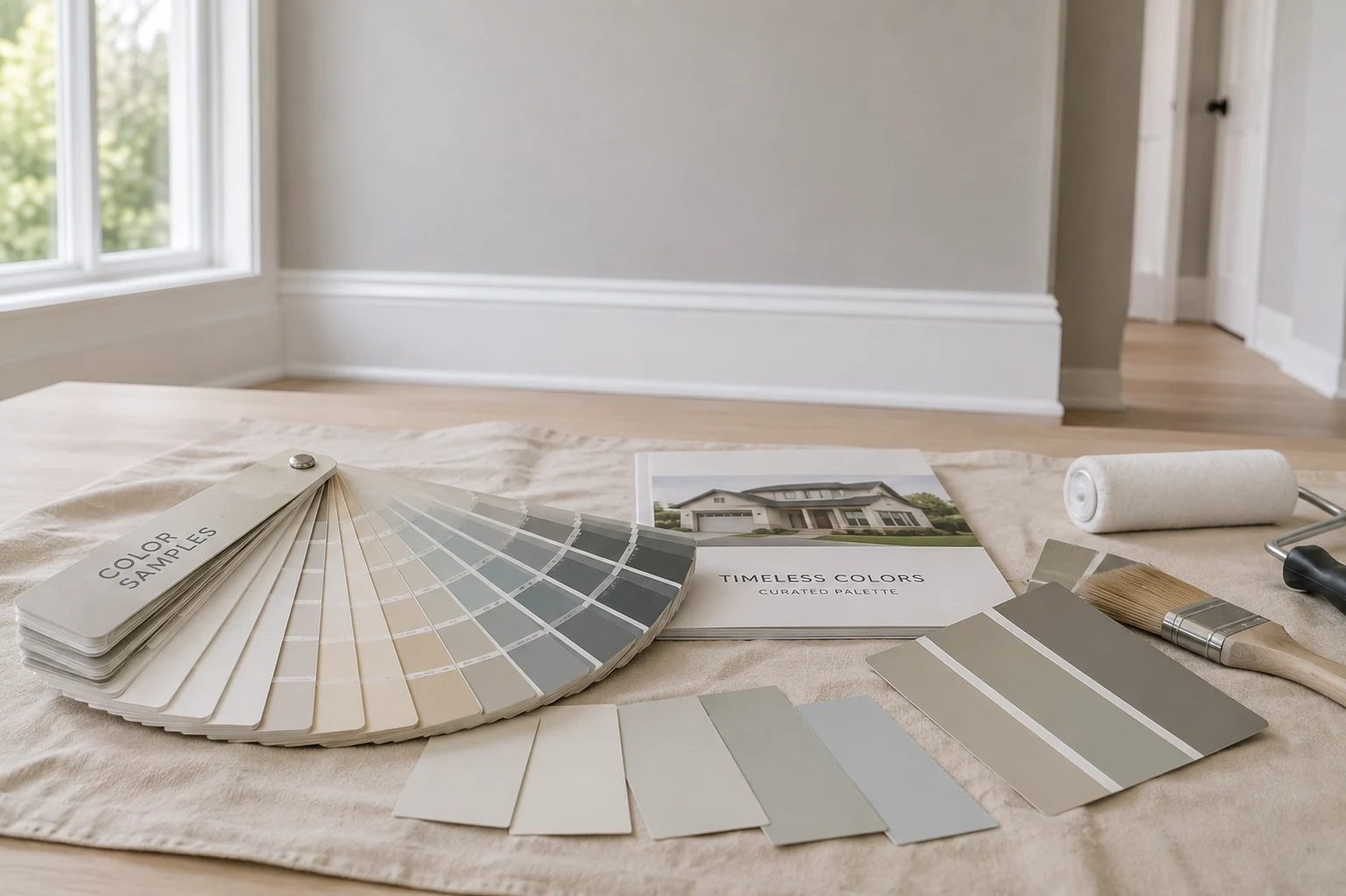
Sample Boards and Swatches
Paint chips are small and viewed under indoor light, and exterior colors look very different in Florida sun. Some committees ask for larger painted sample boards, and some want test patches on the house itself, viewed in daylight. Samples in the actual sheen and product planned help the committee, and the owner, see what the finished house will look like. How roof color, pavers and Florida light narrow the choice before a fan deck is even opened is explained in picking exterior colors that work here.
Neighbor Notification
Some associations ask applicants to notify adjacent neighbors, or to include neighbors’ color schemes so the committee can prevent identical houses side by side. This is a matter of each association’s guidelines, not state law, and many communities do not require it. Where it applies, the application form usually says so.
Timeline for Approval
Florida law does not set a statewide deadline for architectural decisions, and it has no automatic approval if the committee is slow. The timeline comes from the association’s documents and its meeting schedule. Some guidelines give the committee a set number of days to respond; others simply review applications at regular meetings.
Practically, submitting well before booking a painter, and checking when the committee next meets, avoids a crew waiting on paperwork. A complete application with clear samples is the most reliable way to shorten the process.
When a committee denies an application, Florida law requires the denial to be in writing and to state specifically which rule or covenant the application does not meet and which part of the request does not conform. That gives the owner something concrete to fix.
What Happens If You Paint First
Painting without required approval exposes the owner to an enforcement process defined by the documents and by section 720.305 of the Florida Statutes. Depending on the association, that can include a violation notice, a request to submit an application after the fact, fines and, where the color does not meet the standards, a requirement to repaint.
Fines and Remediation Orders
Florida law limits fines to $100 per violation and $1,000 in total for a continuing violation, unless the governing documents set different limits, and a fine below $1,000 cannot become a lien on the home. Before a fine can be imposed, the owner must receive at least 14 days’ written notice describing the violation and what is needed to cure it, and a hearing before a committee of at least three members who are not board members, officers, employees or their relatives. If the violation is cured before the hearing, or as the notice specifies, no fine may be imposed. Any fine payment date must be at least 30 days after the committee’s written findings.
Beyond fines, associations can seek to enforce their covenants in other ways, including legal action, and the cost of repainting to an approved color falls on the owner. The simplest protection is to submit and receive approval before any paint is purchased. Owners facing a dispute over a specific notice may want advice from an attorney familiar with community association law.
Repainting the Same Color
Owners are often surprised that repainting a house in its existing colors may still require an application. Many associations want the submission because the approval ties specific products and color codes to the house, and paint formulas and color names change over time. Faded walls may no longer match the color on record, and a painter matching the faded color by eye can end up with a slightly different shade. Submitting the original codes, or confirming the scheme on file with the manager, keeps the house consistent with what was approved.
Some associations handle same-color repaints with a simplified form or notice rather than full review. The guidelines say which applies.
Getting Non-Standard Colors Approved
Some owners want a color outside the approved palette. Whether that is possible depends on whether the guidelines allow variances and how the committee exercises them. Applications for non-standard colors are more likely to succeed when they:
- Stay close to the palette in tone and lightness, rather than departing entirely.
- Show the color in context, with a large sample on the house and photos from the street.
- Explain the reason, such as a new roof color or updated shutters that the existing scheme no longer suits.
- Consider the neighbors, showing that the color does not duplicate or clash with adjacent homes.
A denial is not always the end; many guidelines provide for reconsideration or an appeal to the board.
A Short Checklist Before You Submit
- Confirm whether your community has an association and architectural guidelines, and get the current versions.
- Find the approved palette and the color scheme on record for your address.
- Decide on colors for every element that will be painted, including doors, shutters and garage door.
- Gather manufacturer names, color codes and samples in the planned sheen.
- Take current photos of the house and, if requested, neighboring homes.
- Check the committee’s meeting schedule and any stated response time.
- Submit before booking the painter, and keep a copy of everything sent.
Documentation a Painting Contractor Can Provide
The approval process goes more smoothly with complete information, and a painting contractor can usually help assemble it:
- The exact products and color codes planned for each surface.
- Sample chips or boards in the planned sheen.
- A written scope describing the surfaces to be painted and any repairs.
- License and insurance certificates when the association requests them.
After approval, keeping the approval letter, the color codes and the product names together with the house records makes the next repaint, and any sale of the home, much simpler.
Front Door and Trim Exceptions
Many palettes allow more freedom on smaller elements than on the main body. Front doors often have a wider range of accent colors, and some communities let owners choose any color from a door palette without a full application. Shutters, trim and garage doors may have their own rules, and some associations require garage doors to match the body or trim.
These exceptions vary so much between communities that assuming them is risky. Checking the guidelines, or asking the manager whether a door-only or trim-only change needs an application, takes a few minutes.
The same associations often review other exterior work too, such as windows, screens and hurricane protection, alongside the building department’s separate process for remodel permits.
Getting the color approval in hand is a normal first step in planning an exterior repaint, and one that is easiest when it is done before scheduling.
Share this article