The short answer
Refacing replaces cabinet doors, drawer fronts and hardware and covers the existing boxes with new veneer or laminate, leaving the boxes, the layout and usually the countertops in place. It makes sense when the boxes are structurally sound and dry, the layout works and the goal is a new look. HomeGuide's national cost data puts refacing at roughly $5,000 to $13,000 for a typical kitchen, and a few days of work.
Replacement is the answer when boxes are swollen, delaminated or water-damaged, particularly under the sink, when the layout needs to change, or when new appliances and storage need different cabinet sizes. Refacing cannot fix structure, moisture damage or a layout that does not work.
Key takeaways
- Refacing changes the surfaces you see; the boxes, the layout and the storage stay exactly as they are.
- The sink base is the first place to inspect. Swelling, soft bottoms or stains there often decide the question.
- Particleboard that has absorbed water swells at the edges and does not recover; plywood tolerates occasional moisture better.
- Refacing and replacement cost ranges overlap. The condition of the boxes and the scope decide which is better value.
- Countertops usually stay during refacing. If they are due for replacement too, the math shifts toward new cabinets.
What Refacing Actually Changes
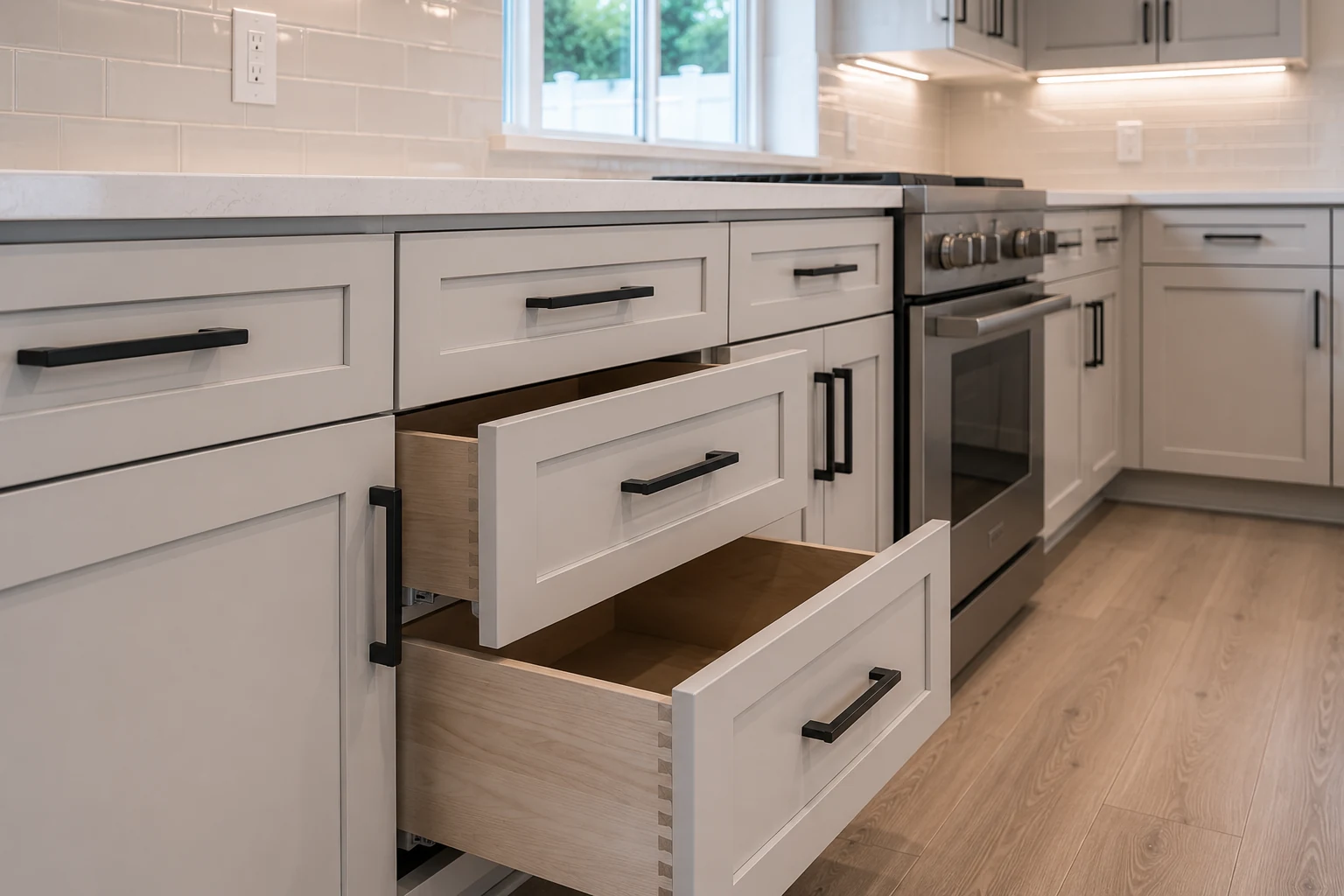
Cabinet refacing replaces the parts of a kitchen’s cabinets that you see and touch while keeping the structure behind them. A typical refacing job includes:
- New doors and drawer fronts, in a new style, material and color.
- New veneer or laminate applied to the face frames and exposed end panels of the existing boxes.
- New hardware: hinges, pulls and knobs, often including soft-close hinges.
- Optional extras such as crown molding, light rail and under-cabinet lighting.
What stays the same: the cabinet boxes, their sizes and positions, the interior shelves, the countertops and the plumbing and appliances. That is the source of both refacing’s advantages and its limits. It changes the kitchen’s appearance without the demolition, plumbing disconnections and countertop removal of a full replacement, but it cannot add storage or change how the kitchen is arranged.
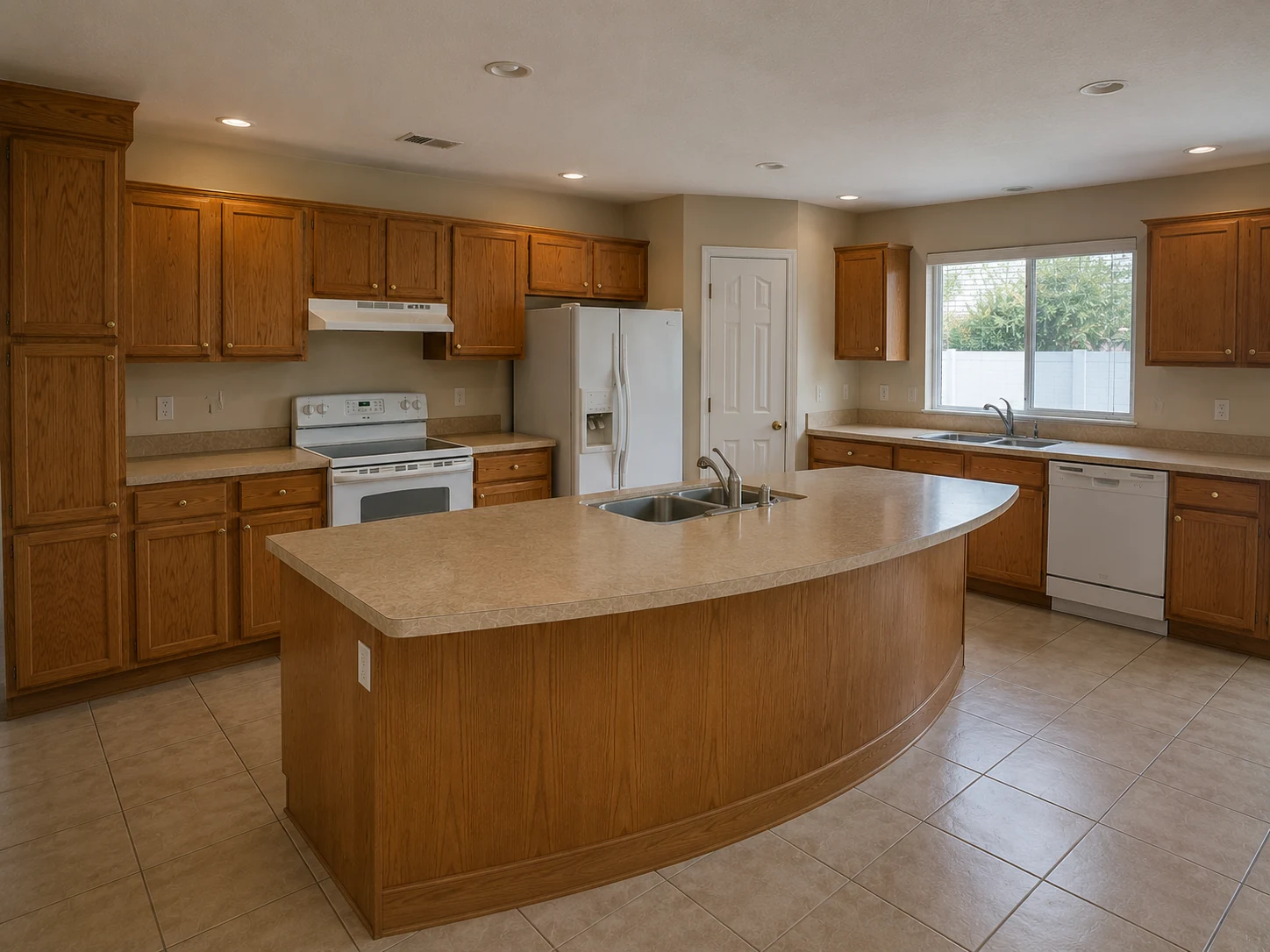
Refacing also differs from painting. Painting keeps the doors and changes their finish; refacing replaces the doors entirely, so a raised-panel oak kitchen can become a flat-slab or shaker kitchen. Painting has its own preparation, primers and cure times, and what cabinet painting can and cannot do is worth comparing before deciding.
When Refacing Is the Right Call
Refacing is a good fit when:
- The boxes are sound: solid, square, dry and securely fastened, with no swelling or water damage.
- The layout works: the sink, range, refrigerator and storage are where you want them.
- The countertops are staying, or can be replaced independently.
- The appliances fit the existing openings, or replacements will be the same sizes.
- The main complaint is appearance: dated door styles, worn finishes, old hardware.
In those conditions, refacing delivers a new-looking kitchen with less disruption than replacement and often in a matter of days.
When Replacement Is the Only Option
Replacement is the better, and sometimes the only, choice when:
- The boxes are damaged: swollen particleboard, delaminated panels, soft or stained bottoms, loose joints.
- The layout has to change: moving the sink or range, adding an island, opening a wall, or reorganizing for how the household cooks.
- Storage is inadequate: more drawers, taller uppers, a pantry wall or deeper cabinets are wanted.
- Appliances are changing size: a wider range, a column refrigerator or a built-in microwave that does not fit existing openings.
- The countertops are being replaced anyway, removing much of the cost advantage of keeping the boxes.
New cabinets can also be ordered in materials suited to the conditions, such as plywood boxes near the sink and dishwasher, and how box and door materials behave in humidity is a useful read before ordering.
How to Inspect Your Cabinet Boxes
Before deciding, look at the boxes, not the doors. Empty the cabinets and use a flashlight.
- Start under the sink. This is where leaks, condensation and dishwasher overflows show first. Look for swelling, bubbling, stains, soft spots and mold.
- Check next to the dishwasher and range, where steam and heat affect the side panels.
- Press on the cabinet bottoms and shelves. They should feel firm, not spongy.
- Look at the joints and corners. Gaps, separation or loose fasteners suggest the box is failing.
- Check that the boxes are level and square, and that face frames are tight to the boxes.
- Look at the back panels and the wall behind, especially on exterior walls, for moisture or pests.
Checking for Swelling and Delamination
Swelling shows as puffed edges, raised seams or a rough, crumbly surface where the laminate has lifted. Delamination is the surface layer separating from the core, often starting at an edge. Both are signs that moisture has gotten into the material. In a sink base, they often mean the bottom panel needs replacing at minimum; across several boxes, they point to replacement. Covering damaged boxes with new veneer only hides the problem until it shows through again.
Why Particleboard Boxes Fail in Florida Humidity
Many production cabinets, particularly in builder-grade kitchens, have boxes made of particleboard: wood particles bonded with resin and covered with a thin melamine or vinyl surface. As long as the surface stays intact and dry, particleboard is stable and inexpensive. When water reaches the core through a cut edge, a screw hole or a damaged surface, the particles swell, the board loses strength and it does not return to its original shape when it dries.
High humidity alone is rarely the cause. What damages boxes is water: slow leaks under sinks, dishwasher overflows, condensation around ice makers and spills that sit. Florida homes add the risk of plumbing leaks going unnoticed for longer when a house is closed up or used seasonally.
Plywood vs Particleboard
Plywood boxes, made of cross-laminated wood veneers, hold screws better and tolerate occasional moisture better than particleboard, though they are not waterproof. Many cabinet lines use plywood for sink bases or offer plywood boxes as an upgrade. Cabinets carrying certification to the ANSI/KCMA A161.1 standard have passed a series of structural and finish tests set by the Kitchen Cabinet Manufacturers Association, which is a useful indicator when comparing new cabinets.
For refacing, the box material matters less than its condition. Sound particleboard boxes can be refaced successfully; damaged ones cannot.
Cost and Timeline Compared
HomeGuide’s cost data gives these national ranges:
| Refacing | Replacement | |
|---|---|---|
| Typical cost | About $5,000 to $13,000 for a typical kitchen | About $4,500 to $15,000 or more |
| Per linear foot | About $150 to $450 | About $100 to $1,200, stock to custom |
| Typical duration | About 2 to 5 days | Longer, including countertops and plumbing |
| Layout changes | No | Yes |
| Countertops | Usually stay | Usually replaced |
The figures in the table are national planning ranges from published cost guides, not quotes. Kitchen size, the veneer or door style chosen and what the boxes need before refacing all move a real bid, sometimes outside the range.
Within refacing, the material drives the price: laminate and thermofoil doors cost the least, wood veneer more, and solid wood doors the most. Labor is a large share of refacing costs.
The ranges overlap because replacement with stock cabinets can cost about the same as refacing with premium doors and veneer. The better comparison is what each option delivers: refacing keeps the existing structure, layout and countertops; replacement buys a new layout, new boxes and usually new countertops. Seeing the cabinet line next to counters, appliances and plumbing in a full kitchen budget usually makes the choice clearer.
Timeline is where refacing clearly wins. A refacing job is usually a matter of days with the kitchen partly usable, while replacement involves demolition, plumbing disconnection, new countertops that are templated after cabinets are set, and often weeks.
Refacing Materials: Laminate, Thermofoil, Veneer and Wood
The new surfaces come in several families, and they behave differently in a Florida kitchen:
- Laminate is a durable plastic surface bonded to a substrate. It resists moisture and wear, comes in solid colors and wood looks, and is among the least expensive options.
- Thermofoil is a vinyl film heat-formed over MDF doors. It gives smooth, often white, shaker-style doors at a low price, but doors beside the oven or above the dishwasher, where hot air and steam hit them daily, are where the film tends to lift first.
- Wood veneer is a thin layer of real wood applied to the frames, paired with wood or veneered doors. It can be stained or painted and looks like solid wood.
- Solid wood doors paired with veneered frames are the most expensive refacing option and the closest to new cabinetry in appearance.
HomeGuide’s national figures show the spread: roughly $80 to $125 per linear foot for laminate or thermofoil, $100 to $250 for wood veneer and $200 to $500 for solid wood. The choice should consider where heat and water hit the doors, not only the look.
What the Refacing Process Looks Like
A typical refacing job runs in a predictable sequence:
- Measuring and ordering. Every door, drawer front and exposed panel is measured, and new doors are ordered to size. This lead time is usually the longest part of the project.
- Preparation. Old doors, drawer fronts and hardware are removed; face frames and exposed sides are cleaned and repaired.
- Applying veneer or laminate to the face frames and end panels, trimmed to fit.
- Installing new doors, drawer fronts and hardware, then adjusting hinges so gaps are even.
- Optional additions such as crown molding, light rail or under-cabinet lighting.
Because the countertops, sink and appliances stay connected, the kitchen remains partly usable during the work, which is one of refacing’s main practical advantages.
A Middle Path: Partial Replacement
Refacing and replacement are not all-or-nothing. Common combinations include replacing a damaged sink base or dishwasher end panel with a new box and refacing the rest, adding a tall pantry or a few new units built to match, or replacing only the doors and drawer fronts while keeping the existing finish on the frames. Matching new boxes to refaced ones takes coordination, since the veneer, door style and finish must be consistent, but it can solve a specific problem without replacing a sound kitchen.
What Refacing Cannot Fix
Refacing is cosmetic by design. It cannot:
- Repair water-damaged or structurally weak boxes.
- Change cabinet sizes or positions, or add drawers where there are doors.
- Fix out-of-level or poorly installed cabinets.
- Improve interior storage, beyond adding organizers.
- Solve plumbing, electrical or ventilation problems behind the cabinets.
Layout Is Frozen With Refacing
The biggest limit is the layout. With refacing, the sink stays where it is, the range stays where it is, and every box keeps its size. If the kitchen’s problems are functional, such as too little counter space, a cramped work zone, no room for an island or a poor path through the room, refacing makes the same layout look newer without making it work better. In that case, the money is usually better spent on a new layout.
Whether refacing or replacement fits a particular kitchen usually becomes clear after an inspection of the boxes and a conversation about how the kitchen is used. Both options are part of kitchen remodeling, and the choice between them sets the scope for everything that follows.
Share this article